 Link to Main Content






The thai parliament
Democracy Parliament is an important legislative body by enacting legislation. To administer the mainland To oversee the administration of the government in accordance with the policy announced to the council. The form of the Thai Parliament since the rule of law since 1932, it appears that the constituent elements of the Parliament depend on the form of Parliament to be a single parliament or two. Including the origin of parliamentarians. Authority, Responsibility and Independence of Parliament This will enable Parliament to become a functioning executive body.
Thailand, we have already used the two systems of Parliament, one parliamentary system. And two parliamentary congressional systems Each system has different characteristics and limitations:
1. Parliamentary Assembly only The key characteristics of a single congressional assembly are: There is only one legislative member, such as the National Legislative Assembly. But the only one in Thailand is split up again.
1.1 A single council consisting of two types of members and two types of members is Members who are directly elected. And the members of the nomination. As can be seen from the Constitution of the Kingdom of Thailand in 1932.
1.2 Single council consisting of only one member There are only members who are appointed, such as the National Legislative Assembly established in accordance with the Constitution of the Kingdom of Thailand BE 2515
2. Second Congress The nature of the two-chamber parliament consists of two types of members: the members of the House of Representatives and the senators or members of the House of Representatives. Member of the House of Representatives from the election The senator from the appointment.
Democracy Parliament is an important legislative body by enacting legislation. To administer the mainland To oversee the administration of the government in accordance with the policy announced to the council. The form of the Thai Parliament since the rule of law since 1932, it appears that the constituent elements of the Parliament depend on the form of Parliament to be a single parliament or two. Including the origin of parliamentarians. Authority, Responsibility and Independence of Parliament This will enable Parliament to become a functioning executive body.
Thailand, we have already used the two systems of Parliament, one parliamentary system. And two parliamentary congressional systems Each system has different characteristics and limitations:
1. Parliamentary Assembly only The key characteristics of a single congressional assembly are: There is only one legislative member, such as the National Legislative Assembly. But the only one in Thailand is split up again.
1.1 A single council consisting of two types of members and two types of members is Members who are directly elected. And the members of the nomination. As can be seen from the Constitution of the Kingdom of Thailand in 1932.
1.2 Single council consisting of only one member There are only members who are appointed, such as the National Legislative Assembly established in accordance with the Constitution of the Kingdom of Thailand BE 2515
2. Second Congress The nature of the two-chamber parliament consists of two types of members: the members of the House of Representatives and the senators or members of the House of Representatives. Member of the House of Representatives from the election The senator from the appointment.
Historical Background
The National Peace Corps (KBC), consisting of the Royal Thai Army, Royal Thai Navy, Air Force and the Royal Thai Police. Has entered into the governing power of the country since 22nd May 2557 at 16.30 onwards, by declaring the Constitution of the Kingdom of Thailand BE 2550 ending except in Section 2 King. And have promulgated the Constitution of the Kingdom of Thailand. (Provisional), July 2557, on July 22, 2014, with the reasons for seizing power as shown in the foreword of the Constitution. (Provisional), BE 2557: "As the political conflicts in Bangkok and surrounding areas have continued for a long time. Until it spread to almost every region of the country. People break into different parties, lack of harmony and attitude are not friendly to each other. Sometimes violent Use of force and weapons of war to assault persecution. The welfare and well-being of people are not normal. Economic and political development, disruptive administration, affecting the exercise of legislative, administrative and judicial power. Law enforcement does not work. It is a terrible crisis never before. Although the state has resolved the problem through legal mechanisms and measures, such as the adoption of laws on the maintenance of public order in various circumstances, the dissolving of the House of Representatives and the establishment of general elections. And parties that are not parties, such as private business organizations, constitutional organizations, political parties, the military, and the Senate, have tried to reconcile negotiation. But it did not work. There will be new legal and political disputes. A whirl of unending issues While the conflict has expanded exponentially and tends to intensify until the riots are over, it can endanger the lives, property, comfort, and integrity of the people. Impact on the livelihood of farmers. Especially farmers Economic development of the country Prevention of natural disasters Trust in state power. And the confidence of foreign investors. It also opened the door to more crime and unrest. It will destroy the national security and the people's faith in the democratic system of monarchy. Constitution of the Kingdom of Thailand (Provisional), BE 2557, Section 6, provided that The "National Legislative Assembly" is composed of up to 220 members, appointed by the King, according to the National Peace Corps, offering advice from Thai nationals by birth and at least 40 years of age. Knowledge And diversity of individuals from the public, private, social, professional, and other sectors that will benefit the performance of the state legislature.
Source: Chulalongkorn 11, Issue 4 July - August 2014, Legal Office, The Secretariat of the Senate
Source: Chulalongkorn 11, Issue 4 July - August 2014, Legal Office, The Secretariat of the Senate
Roles, Powers and Duties
In the event of a problem with the legislative branch of the state legislature. And this is not the case with the provisions of this Constitution that will apply to such cases. The National Assembly is the deciding judge.
(Section 6, paragraph two), the National Legislative Assembly acts as the House of Representatives, the Senate and the Parliament.
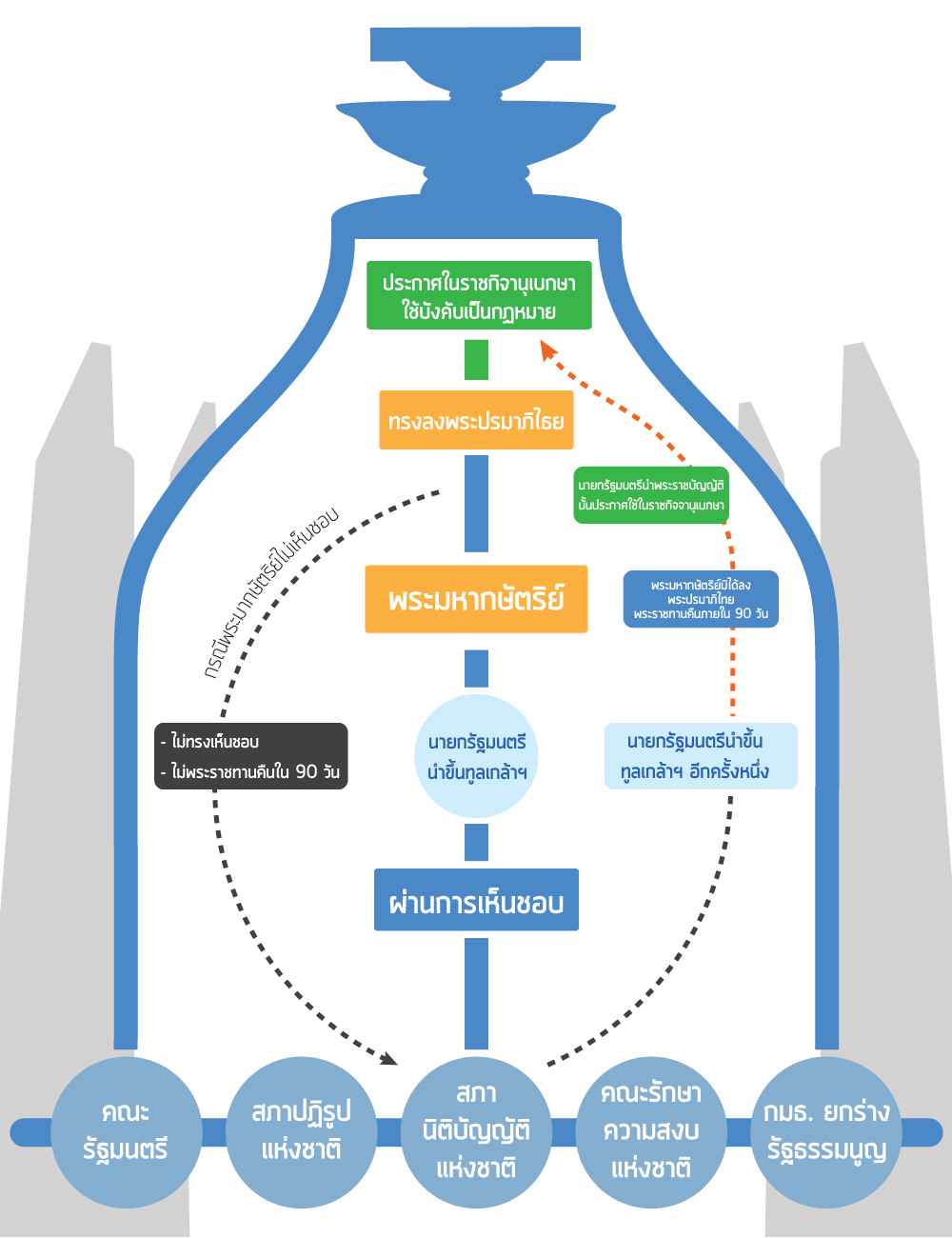
Constitution of the Kingdom of Thailand (Provisional), BE 2557, provides for the King to enact the Act by the advice and consent of the National Legislative Assembly. The bill will be proposed by not less than 25 members of the National Legislative Assembly or the Cabinet. Or the National Reform Council under Section 31 paragraph two, but the financial bill shall be proposed only by the Cabinet. The Financial Act means a bill relating to the setting up, cancellation, reduction, alteration, extension, or enforcement of taxes or duties, allocation, treatment, or payment of funds. Or transfer the budget of the land, loan Guarantee Or the use of a loan Or action that binds the property of the state In the case where it is suspected that the bill proposed to the legislature is a financial bill? The President of the National Assembly is the judge. By a bill proposed by a member of the National Legislative Assembly or the National Reform Council, The Cabinet may request a review before the National Legislative Assembly adopts the principle. The enactment of the Organic Act shall be effected in the same manner as the enactment of the Act. However, the proposed bill shall be made by the Cabinet or the person in charge of the Organic Act. The bill and the draft legislative act approved by the legislature. The Prime Minister shall bring up to the Minister within 20 days from the date of receipt of the bill or the draft Organic Act from the National Legislative Assembly for the King to sign the monarch. And when published in the Gazette. Applicable law
In the case of any bill or bill The King did not approve and returned to the National Legislative Assembly. The national legislature will have to consult the bill or bill. If the National Assembly has the same resolution, by a vote of not less than two-thirds of all existing members. Let the Prime Minister bring the bill or the bill into the Constitution again. When the King has not signed his name and returned within 30 days, the Prime Minister shall bring the Act or the Organic Act into force in the Government Gazette, as if the King had signed him.
When there is an urgent emergency, for the sake of maintaining the security of the Kingdom. Public safety Economic stability of the country Or prevent a public disaster Or when it is necessary to have a tax or currency law to consider urgently and secretly. The King has the power to enact an Emergency Decree, such as the Act When the decree was enacted. The Cabinet shall propose such an Emergency Decree to the National Legislative Assembly without delay. If the National Assembly approves The enactment of the Emergency Decree shall continue to be effective as the Act onwards. If the National Assembly does not approve The decree shall be repealed but shall not affect the business of the period during which the Emergency Decree came into force. Unless the Emergency Decree has the effect of amending or repealing any law. Provided that the provisions of the law existing prior to amendment or termination shall continue to apply from the date of the death of such decree. Approval or disapproval of an Emergency Decree shall be published in the Government Gazette. In case of disapproval, effective from the date of publication in the Government Gazette.
Any member of the national legislature acts as a derogatory measure of being a member of the legislature. Or a circumstance which hinders the performance of duties of members of the Legislative Assembly. No less than 25 members of the National Legislative Assembly have the right to petition the President of the National Legislative Assembly. For the National Legislative Assembly to pass a resolution to free the member.
The National Legislative Assembly has the power to enact regulations governing the election and performance of duties of the President, Vice-Presidents and the Commission. How to Meet Proposing and Considering Draft Bill and Draft Organic Proceedings Proposals, Debates, Voting, Drafting Keeping order and order And other undertakings to carry out the authority
At the National Legislative Assembly All members have the right to ask the Minister. In any matter about the task on the page. But the minister has the right not to respond when he sees that the matter should not be disclosed because of the safety or important interests of the land. In this case, the National Legislature will enact a quorum, which is different from that provided for in Section 13, paragraph one.
When there is a problem National Legislature is not less than one-third of all members. To be nominated for a motion to open a debate to question the facts of the Cabinet, but to vote for trust or not trust.
In cases where there are major problems with the administration of the land, the Cabinet deems it appropriate to listen to the opinions of the members of the National Legislative Assembly. The Prime Minister will inform the President of the National Legislative Assembly so that a general debate can be held at the Legislative Assembly. But the national legislature will vote on the issue at issue.
The king appoints a prime minister in accordance with the resolution of the council and holds the royal mandate to vacate the prime minister's office, as the president of the National Legislative Assembly is presenting the recommendations of the National Legislative Assembly. National peace By appointing the Prime Minister and leaving the Prime Minister vacated. The President of the National Legislative Assembly Signs the Royal Command.
Which contract has changed the territory of Thailand. Or territory outside the territory Thailand has sovereignty or jurisdiction under the treaty or international law. Or to issue a law to comply with the contract. Or that affect the country's economic or social security widely. Must have the approval of the National Legislative Assembly. In this regard, the National Legislative Assembly must consider the completion within 60 days from the date of receipt of the matter. A contract that affects the economic or social security of a country extensively means. Free Trade Agreement Joint Customs Area Or the use of natural resources or cause the country to lose all or some of its rights to natural resources. Or otherwise as required by law.
here is a commission to draft a constitution to prepare a draft constitution. It consists of 36 commissioners appointed by the president of the National Reform Council.
(1) Chairperson of the National Peace Corps Commission
(2) The National Reform Council proposed 20 people.
(3) who is proposed by the National Assembly of 5
(4) The Cabinet proposes 5 people.
(5) whom the National Peace Corps proposes for 5 people.
Appointment of Commissioner of Constitution Drafting It must be completed within 15 days from the date of the first National Reform Council meeting. In case the Constitutional Commissioner vacates office for any reason Let the remaining Constitutional Commission continue to carry out its duties.
By the Constitution Drafting Committee, the Constitution Drafting Committee is to be held as long as the Constitutional Commission remains in place. However, the President of the National Reform Commission shall appoint a commission to draft the Constitution in lieu of such vacancy in accordance with the above-mentioned criteria within 15 days from the date the Constitutional Commission vacates office.
(1) Chairperson of the National Peace Corps Commission
(2) The National Reform Council proposed 20 people.
(3) who is proposed by the National Assembly of 5
(4) The Cabinet proposes 5 people.
(5) whom the National Peace Corps proposes for 5 people.
Appointment of Commissioner of Constitution Drafting It must be completed within 15 days from the date of the first National Reform Council meeting. In case the Constitutional Commissioner vacates office for any reason Let the remaining Constitutional Commission continue to carry out its duties.
By the Constitution Drafting Committee, the Constitution Drafting Committee is to be held as long as the Constitutional Commission remains in place. However, the President of the National Reform Commission shall appoint a commission to draft the Constitution in lieu of such vacancy in accordance with the above-mentioned criteria within 15 days from the date the Constitutional Commission vacates office.
In the drafting of the Constitution, the Constitution Drafting Committee brings the opinions or suggestions of the National Legislative Assembly into consideration.
Where deemed necessary and appropriate. The Cabinet and the National Peace Corps will jointly decide to amend the Constitution. By drafting a constitutional amendment to be submitted to the National Legislative Assembly for approval. The National Legislative Assembly shall consider or approve the draft amendment within 15 days as from the date of receipt of the revised constitution. The National Legislative Assembly will amend it further. The draft amendment to the Constitution does not. Unless the Cabinet and the National Peace Corps agree. The resolution must be voted for by no less than half of the total number of members of the Legislative Council. When the National Legislative Assembly approves the revised constitution The Prime Minister shall bring the constitutional amendments to the Constitution to be presented within 15 days from the date the National Legislative Assembly resolved. When the King signs down. And when it is published in the Government Gazette, then it shall be enforceable by the Prime Minister to sign the Royal Command. In case the King does not agree with the draft constitution, amend it and return it. Or when the 90-day deadline is not returned. The draft amendment to the Constitution goes away.